
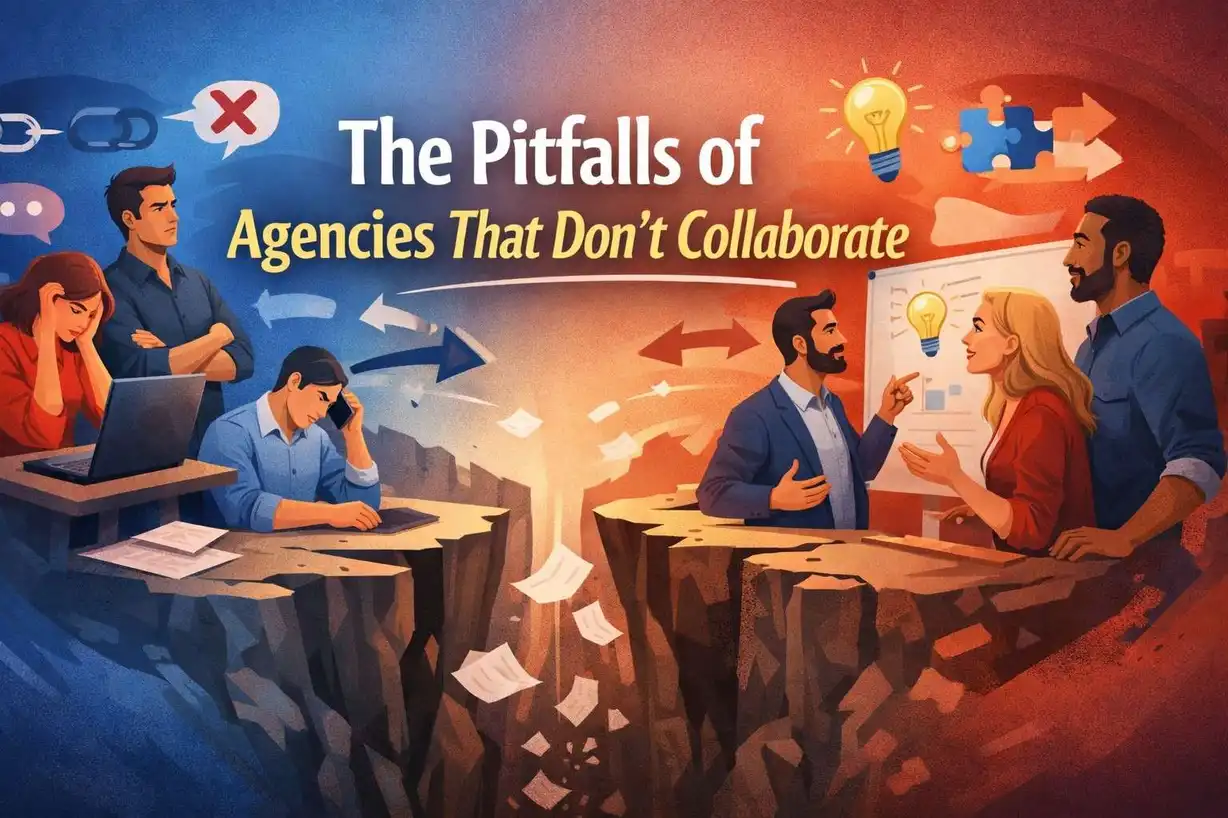
You hired an agency to take things off your plate. To reduce complexity, streamline execution, and help you move faster. Instead, you received reports filled with metrics but little interpretation. Conservative strategies that felt safe, but failed to deliver momentum.
What you actually needed was a partner who would challenge assumptions, refine your direction, and push consistently toward measurable outcomes.
When that doesn’t happen, the issue is rarely the channel or the budget. More often, it’s the nature of the relationship itself.
When Execution Replaces Partnership
Most organizations struggle because ideas are not questioned, connected to business outcomes, or translated into decisive action.
This is where marketing agency collaboration problems typically begin. Many agencies position themselves as service providers rather than strategic partners, focusing on output instead of outcomes.
The result is a working relationship that feels productive on the surface, but delivers limited impact over time.
The Problem With “For You” Agencies
Agencies that work for clients tend to prioritize delivery over direction. While this may feel efficient initially, it often leads to misalignment and missed opportunities.
Common characteristics include:
- Accepting budgets and briefs without strategic challenge
- Executing plans even when assumptions are flawed
- Failing to bring market context or competitive insight
- Limited engagement between reporting cycles
- Prioritizing short-term satisfaction over long-term growth
These are clear signs your agency isn’t a true partner. Without constructive tension and accountability, marketing becomes activity-driven rather than results-driven.
Communication Gaps That Stall Progress
One of the most frequent concerns clients raise is the lack of meaningful dialogue. Not missed deadlines, but missing perspective.
- Updates arrive without explanation.
- Reports lack interpretation.
- Recommendations are absent.
These agency communication issues in marketing create a disconnect between effort and impact. When strategy is not discussed openly and regularly, performance suffers. Marketing requires ongoing conversation, not transactional updates.
What “With You” Agencies Do Differently
Agencies that work with clients operate as collaborators, not order-takers.
They:
- Ask difficult but necessary questions
- Challenge objectives that lack clarity or feasibility
- Bring insights proactively, not reactively
- Align marketing activity with business priorities
- Function as an extension of the internal team
This distinction highlights the difference between marketing strategy vs task execution. Execution alone delivers outputs. Strategy delivers outcomes.
True partners focus on alignment, accountability, and shared ownership of results, creating real client-agency alignment for growth.
Transparency Builds Trust and Performance
Effective partnerships are built on clarity. This includes open discussions about performance, trade-offs, and decisions.
Strong agencies practice agency transparency and reporting that goes beyond dashboards. They explain what is working, what is not, and what will change as a result. This level of openness builds trust and enables faster, more confident decision-making.
The Triad Needs Partners, Not Vendors
Most leadership teams are not lacking marketing capability. What they lack are partners who think beyond individual tactics.
If an agency is running campaigns or producing content without understanding revenue goals, sales cycles, or business constraints, the relationship is transactional. In that scenario, you are working with a vendor, not a partner.
Effective outsourced marketing teams integrate closely into planning, decision-making, and performance reviews. The best partners take ownership of outcomes, not just deliverables.
Evaluating the Relationship Honestly
Understanding how to evaluate your marketing agency requires asking direct questions:
- Are they proactive or reactive?
- Do they challenge ideas constructively?
- Do they connect activity to business results?
- Are they consistently engaged beyond delivery?
If these answers raise concerns, leaders often begin considering switching agencies without losing momentum. While change can feel disruptive, remaining in a misaligned relationship often carries greater long-term risk.
Managing the Relationship
Before making a change, it is worth reassessing how to manage an agency relationship. In some cases, expectations were never clearly defined. In others, roles evolved without alignment.
However, when expectations are clear and progress remains limited, the issue is fit. Strong agencies do not require constant oversight. They take initiative and ownership.
Final Thoughts
Marketing growth rarely comes from comfortable relationships. It comes from shared accountability, informed challenge, and strategic collaboration. If your agency works for you, you will receive what you request. If your agency works with you, you will gain perspective, direction, and momentum.
That distinction defines the difference between activity and impact.
If you are seeking a partner who engages strategically, challenges constructively, and aligns marketing with business outcomes, it may be time for a different approach.
New Path Digital works with clients as strategic partners. We collaborate closely, ask the right questions, and focus relentlessly on results.
Schedule a strategy session with New Path Digital today!
FAQs
1. How long does it typically take for an agency partnership to show strategic value?
Strategic value should begin to emerge within the first quarter, through clearer direction, better alignment, and more informed decision-making.
2. Is disagreement between a client and agency a negative sign?
No. Constructive disagreement often leads to stronger strategies and better outcomes when handled professionally.
3. Can an agency act as a partner without full access to internal data?
Partnership is strongest with transparency. Limited access can restrict impact, but good agencies will clearly communicate what they need to be effective.
4. Should agencies be involved in business planning discussions?
Yes. Agencies deliver greater value when they understand broader business objectives and constraints.
5. What is the most common reason agency relationships fail? Misaligned expectations, particularly around strategy, ownership, and outcomes—are the most common causes.
This blog was last updated on 2 weeks ago by Siliveru Rakesh